



Modern Wood Slat Wall Design Guide 2026: Layout, Spacing, Acoustics
Modern slat walls create a consistent cadence and a softer soundscape. Genuine wood on a stable core with acoustic backing keeps lines crisp and rooms calm for walls and ceilings in sleek, contemporary spaces. Yet success depends on precise layout, spacing, and absorption strategy. This guide reveals the framework - and the subtle decisions that change everything.
What Is Modern Wood Slat Wall Design
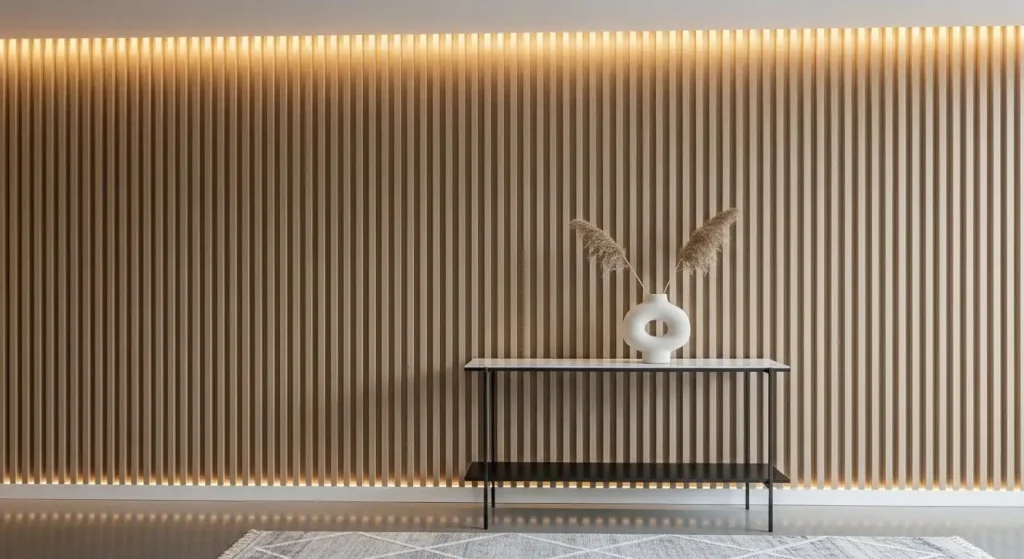
Modern Wood Slat Wall Design uses repeated wooden slats mounted over a stable backing to create rhythm, warmth, and acoustic control. The slats can run vertically or horizontally. They can frame an entry, wrap a feature wall, or zone open-plan spaces without closing them off. When paired with an acoustic felt or mineral backing, the system absorbs unwanted echo while keeping a clean, modern look.
Think of it as a kit: slats, spacing, backing, and layout. Get these right, and you get a wall that looks refined, installs fast, and sounds calm.
Planning a Layout That Works
Start with the room. The best layouts respect circulation, sightlines, and power points. Map focal areas, like a reception desk or media wall, then balance slat coverage around them. Vertical slats make ceilings feel higher and draw the eye upward. Horizontal slats widen narrow halls and calm busy surfaces.
• Set visual rhythm. Repeat a slat module from floor to ceiling to create order. Break it intentionally at doors or art to avoid visual noise.
• Plan access. Leave removable panels near wiring and AV zones. Hidden clips allow future maintenance without damage.
• Coordinate lighting. Indirect light grazes slats and enhances texture. Keep 50 - 100 mm clearance behind linear lights to avoid hot spots.
Room Types
• Living rooms: use Modern Wood Slat Wall Design on one or two walls near seating to reduce echo and add warmth.
• Offices: zone collaboration areas; slats with acoustic backing help speech privacy without full partitions.
• Restaurants: wrap booths or bar fronts; absorb crowd noise while keeping an open feel.
Getting Spacing Right
Spacing is the small decision that changes both look and performance. For Modern Wood Slat Wall Design, spacing usually ranges from 10 - 25 mm between slats, with slat thickness around 12 - 25 mm. Narrow spacing reads refined and continuous. Wider spacing looks more open and is more sound-absorptive when used with felt backing.
• A balanced aesthetic: 12 - 18 mm spacing creates a clean, modern rhythm for most interiors.
• Better voice clarity: 18 - 25 mm spacing over 9 - 12 mm acoustic felt increases absorption in the 500 - 2,000 Hz range, the band most important for speech.
• Hidden integration: reserve 20 - 30 mm spacing where you need cable drops or slim linear lighting; mask them behind the pattern.
Mind edges and corners. Use starter and end slats that match your pattern to avoid thin “sliver” pieces. At outside corners, miter slats or use matching corner profiles for a continuous look. Keep a 3 - 6 mm shadow gap to adjacent surfaces to control tolerances and make service lines accessible.
Acoustics You Can Trust
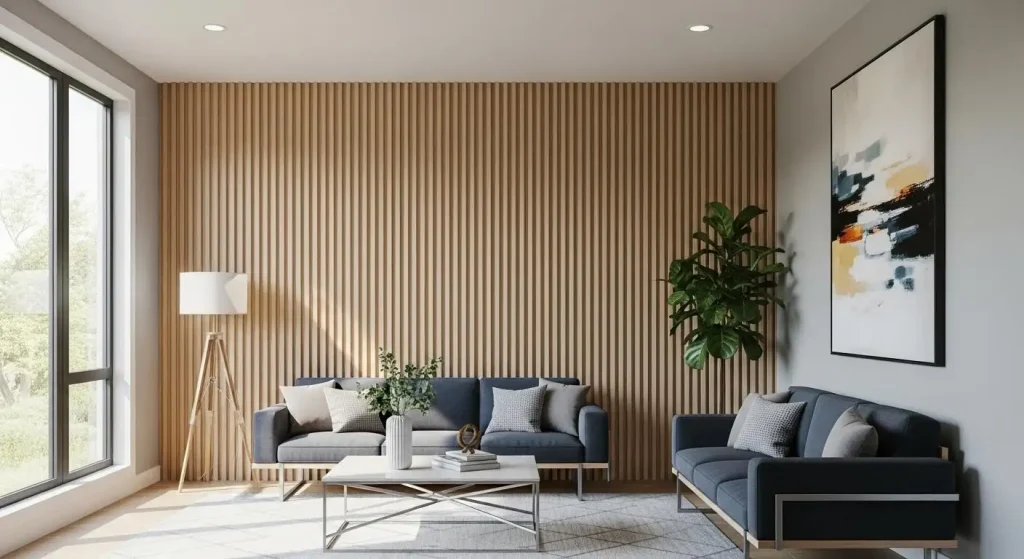
Modern Wood Slat Wall Design can do real acoustic work, not just decoration. When slats sit over an acoustic felt or mineral backing, the system becomes a hybrid absorber and diffuser. This reduces flutter echo and shortens reverberation time (RT60).
Testing and Numbers
• Typical acoustic felt thickness: 9 - 12 mm. With slats, many systems achieve Noise Reduction Coefficient (NRC) around 0.60 - 0.75, depending on spacing, slat depth, and backing.
• Practical result: in a 30 m² office with hard floors and glass, RT60 might be ~0.9 seconds. Covering two opposing walls with slat-absorber panels can bring RT60 down to ~0.5 - 0.6 seconds, improving speech clarity and reducing listener fatigue.
• Mounting matters: a small air gap (10 - 25 mm) plus porous backing increases low - mid absorption. Decoupling rails reduce vibration transmission.
Install where reflections are strongest. For seating areas, treat the wall behind the listener and one adjacent wall. For meeting rooms, treat the wall opposite the primary speaker location and the rear wall. You do not need full coverage; 20 - 40% of wall area in the right places often delivers a noticeable change.
Compliance and Sustainability
Modern Wood Slat Wall Design must meet code and fit your goals for healthy materials. Select finishes backed by test certificates and sourcing records.
• Fire performance: Class A (ASTM E84: 0 - 25 FSI; ≤450 SD) or B-s1,d0 (EN 13501-1). Ensure the entire assembly - slats, backing, adhesive - meets the rating.
• Air quality: choose low-VOC finishes and adhesives; GREENGUARD Gold and CARB Phase 2 compliance indicate low formaldehyde and VOC emissions.
• Accessibility: respect protrusion rules. In public corridors, wall features should not project more than 4 inches (about 100 mm) into the path at heights between 27 - 80 inches.
• Sustainability: FSC-certified wood supports responsible forestry. Engineered wood stores carbon; a cubic meter of wood can store roughly 0.7 - 1.0 tonnes of CO2-equivalent over its life. Durable UV-cured finishes extend service life and reduce refinishing cycles.
These facts protect your project. They also reassure clients and users that the space is safe, comfortable, and low in environmental impact.
Materials and Finishes That Last
Materials
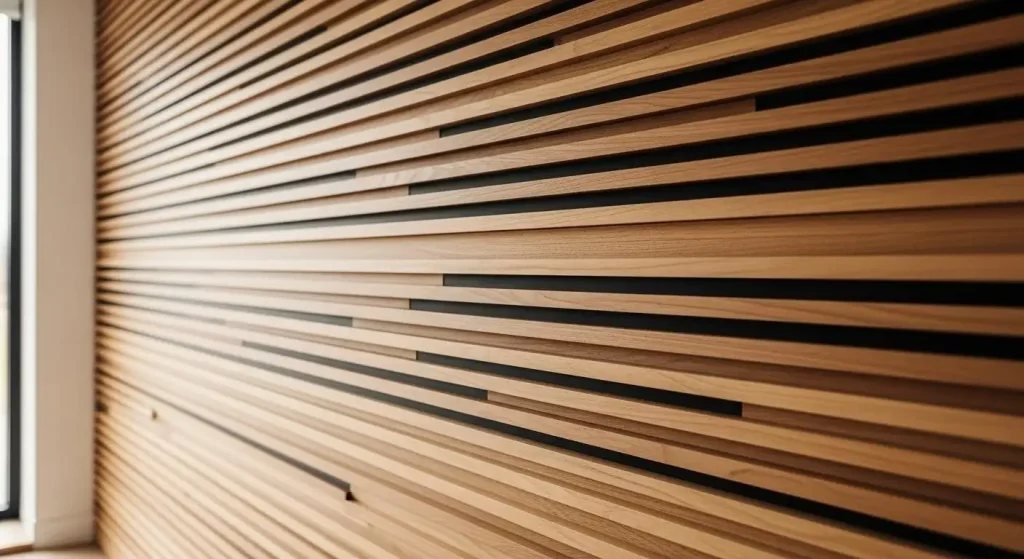
• Oak: Dense, durable, warm grain; resists dents and high-touch wear. Great for residential feature walls and hotel lobbies; pairs with UV-cured matte finishes in Modern Wood Slat Wall Design.
• Ash: Bright, uniform grain; takes stain predictably for refined modern lines. Ideal for offices and retail fronts where consistency and value drive the spec.
• Walnut: Deep, luxurious brown; variation diminishes the look of minor wear. Fit for executive suites, hospitality lounges, and premium reception backdrops.
• Engineered Cores: Multi-ply/MDF-ply constructions that hold shape across seasons. Choose for large Modern Wood Slat Wall Design panels in HVAC-variable areas.
• Solid-Wood Veneers: Weight-efficient premium look; genuine veneer bonded to a stable core reduces load and warping risk. Perfect for high-rise and load-restricted retrofits.
• Acoustic Felt (Recycled PET): Recycled content, real results - NRC gains up to ~0.70 with 9 - 12 mm felt. Place behind slats to quiet meeting rooms and open-plan areas.
• Mineral Fiber Boards: Maximum absorption for critical listening - specify for studios, libraries, or conference rooms; fire-safe options available. Use in studios, libraries, conference rooms; protect edges and adhere to fire-rating standards.
Finishing
• UV-Cured Coatings: High scratch resistance, low VOC, quick processing. Best for education, office, and healthcare interiors requiring tough, compliant finishes.
• Oiled Finishes: Straightforward maintenance; patina grows with use. Selected for boutique retail and residential projects seeking an organic touch.
• Matte, Open-Pore Finish: Low glare, low fingerprints; soft visual depth. Perfect for high-traffic corridors, stair cores, and tactile surfaces.
Clear Benefits, Every Day
• 30 - 50% faster installs vs site-built slats - shorter disruption, lower labor spend.
• NRC up to ~0.70 from 9 - 12 mm felt - better speech clarity, calmer ambience.
• Easy access to services - removable slats keep upgrades simple and low-risk.
• Built-in durability - engineered cores + UV coats resist warping and scratches.
• Sustainable materials - FSC wood + recycled felt align with LEED and similar goals.
Call to Action: Ready to specify Modern Wood Slat Wall Design? Ask for a sample kit and a 20-minute layout review. We'll confirm spacing, acoustic targets, code compliance, and deliver a clear installation plan. Reach out today.


