



Solid Timber vs Engineered Wood Slat Panels: Which to Choose?
The debate over solid timber slat wall panels vs engineered wood panels is one of the most important you will have. Slat walls are a top trend, but this choice is critical. It is a choice between pure, natural character and modern, stable performance.
Solid timber is 100% natural wood. It is heavy, authentic, and full of character. Engineered wood is a smart "sandwich" of a real-wood top layer on a stable, man-made core.
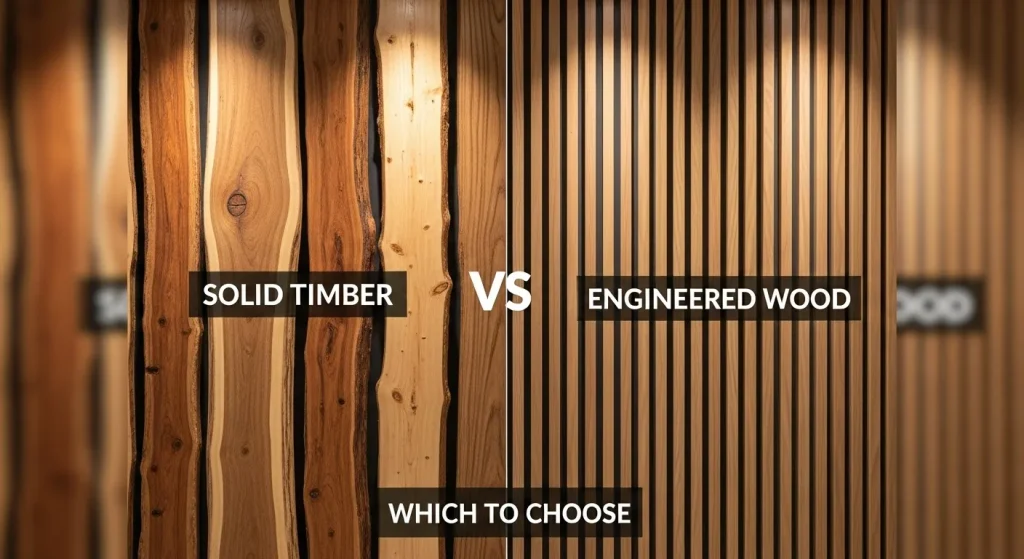
Choosing the wrong one can lead to a warped, buckled wall or a missed opportunity. This guide will compare every single factor. We will cover stability, cost, durability, and installation, so you can make a choice with complete confidence.
What Are Solid Timber Slat Wall Panels?
Solid timber slat wall panels are made from 100% pure, natural wood.2 Each slat is milled from a single, solid piece of lumber. Common woods include oak, walnut, ash, or pine. They are chosen for their authentic grain, knots, and natural beauty.3
This is the "purist's" choice. What you see is what you get. The grain you see on the front of the slat runs all the way to the back. These panels can be sanded, stained, and refinished many times over their life. They are the classic, "heirloom" option and bring a deep, natural character to a room.
What Are Engineered Wood Slat Panels?
Engineered wood slats are a composite "sandwich" material.4 They have a thin top layer (veneer) of real hardwood (like oak or walnut).5 This veneer is then bonded to a very stable core. The core is usually made of MDF (Medium-Density Fiberboard) or plywood.6
This construction is a modern solution. You get the 100% real-wood look from the veneer. But you get perfect stability from the engineered core. The core is inert; it does not move with humidity. These panels are often sold pre-mounted on a black, acoustic-felt backing for easy, all-in-one installation.
What Is the Main Difference Between Solid Timber and Engineered Slats?
The main difference is stability. Solid timber is a natural material that "moves" (expands and contracts) with changes in air humidity.7 Engineered wood has a stable, man-made core that does not move.8 This makes engineered slats far more stable and resistant to warping.
This is the most important concept to understand.
Wood is "hygroscopic." It acts like a bundle of straws. In a humid summer, it absorbs moisture from the air and expands. In a dry winter, it releases moisture and shrinks.
Why Wood Movement Matters
I was once called to inspect a "failed" slat wall. The homeowner had spent a fortune on solid, American-walnut slats. They were installed in the winter, when the air was very dry. The installer, wanting a "perfect" look, fitted every plank tightly together.
When summer came, the humidity in the home rose. The solid walnut planks absorbed this moisture and expanded. They had nowhere to go. The entire wall buckled and "popped" off the drywall.
This is a classic, costly mistake. It is why solid timber must be given "expansion gaps" and a long acclimatization period. Engineered panels, with their stable core, do not have this problem. They are a much safer, more forgiving choice for most modern homes.
At-a-Glance Comparison: Solid Timber vs. Engineered Wood
This table breaks down the key differences to help you make a fast decision.
| Feature | Solid Timber Slat Panels | Engineered Wood Slat Panels |
| Composition | 100% Solid Wood (Oak, Walnut, etc.) | Real Wood Veneer + MDF/Plywood Core |
| Stability | Low. Moves, warps, cups with humidity. | High. Very stable core. Resists warping. |
| Aesthetics | 100% authentic, deep grain, knots. | 99% authentic, more uniform grain. |
| Durability | High. Can be scratched, but sanded/refinished. | Medium. Veneer can be scratched/chipped. |
| Refinishing? | Yes, multiple times over its life. | No. The veneer is too thin to be sanded. |
| Cost | High to Very High | Medium to High |
| Installation | Harder (acclimatization, gaps needed). | Easier (more stable and forgiving). |
| Best For... | Purists, heirloom projects, dry climates. | Most homes, DIY projects, basements. |
Which Panel Looks More Authentic?
Solid timber panels look 100% authentic because they are. They show the deep, natural grain, knots, mineral streaks, and "imperfections" that define real wood. Engineered panels look 99% authentic, but the veneer can sometimes be more uniform.
For most people, the visual difference is almost zero. A high-quality engineered panel with a "thick-sawn" veneer is a perfect match for solid wood.
Where solid timber wins is "character." If you want a rustic wall with big, open knots and a lot of variation, solid timber is the only way to get it. Engineered veneers are often "select grade," meaning they are chosen for their clean, uniform appearance.12
Which Slat Panel is More Durable?
This is a two-part answer. Engineered panels are more stable and resist warping.13 Solid timber is more durable in the long term, as it can be fully repaired and refinished.
Stability (The Winner: Engineered)
As we covered, the engineered core is inert. It will not warp, cup, or bow. This makes it a much better choice for any area with humidity swings, like a kitchen-adjacent wall or a basement.
Scratch & Dent Repair (The Winner: Solid Timber)
This is the big trade-off. If you scratch a solid oak slat, it is still solid oak under the scratch. You can lightly sand the scratch out and re-apply some oil.
If you scratch an engineered slat deeply, you can go right through the thin wood veneer and expose the light-colored MDF core. This is very difficult to hide and cannot be "sanded out."
Long-Term Durability (The Winner: Solid Timber)
A solid timber wall can be a "forever" product. In 20 years, if the finish is worn or you want a new color, you can sand the entire wall down and re-stain it. It is like having a brand new wall.
You cannot sand an engineered panel. The veneer is often less than 1mm thick. A sander would go through it in seconds. The finish you buy is the finish you have for life.
How Does Cost Compare?
Solid timber is almost always more expensive than engineered panels. You are paying for a thick, solid piece of premium hardwood. Engineered panels are more efficient, using only a thin, precious slice of that wood over a cheaper core.
The cost difference comes from simple material volume.
- Solid Slat: A 1-inch thick slat of solid walnut is 100% premium walnut.
- Engineered SAT: A 1-inch thick slat is 95% low-cost MDF and 5% premium walnut.
The savings are built into the design of the engineered panel. This is especially true for exotic or expensive woods. A solid teak or white oak panel wall will be far more expensive than its engineered counterpart.
Which is Easier to Install?
Engineered wood slat panels are much easier and more forgiving to install. This makes them a far better choice for a DIY-er. Solid timber requires a pro-level understanding of wood movement, acclimatization, and precise expansion gaps.
Here are the key installation differences:
1. Acclimatization (The "Waiting Game")
- Solid Timber: This is non-negotiable. You must let the solid wood panels sit in the room for at least 72 hours (3-5 days). This lets the wood get used to your home's humidity. Installing it "off the truck" will lead to the "buckled wall" story I told earlier.
- Engineered: This is still a good idea, but 24-48 hours is usually fine. The core is so stable that it is less of a risk.
2. Cutting the Panels
- Both: You will need a good saw (like a miter saw) with a fine-toothed blade for clean cuts.
- Pro-Tip: To avoid "tear-out" on the wood veneer, wrap the cut-line with blue painter's tape before you cut. Cut right through the tape. This holds the wood fibers in place and gives you a factory-perfect, clean edge.
3. Expansion Gaps
- Solid Timber: You must leave a 1/4-inch to 1/2-inch gap at the top (ceiling) and bottom (floor). This gap allows the entire wall to "float" and expand/shrink. The gap is hidden by your crown molding and baseboard.
- Engineered: The movement is almost zero. You can be much tighter with your tolerances.
What About Sustainability and Eco-Friendliness?
Engineered wood is generally the more sustainable and eco-friendly choice.14 This is surprising to some, but it comes down to material efficiency.
- Engineered: It uses a tiny, thin slice of the valuable, slow-growing hardwood (the veneer). The core is made from fast-growing wood fibers or even recycled sawdust. One log can produce 10-20 times more engineered panels than solid panels.
- Solid Timber: It is very resource-intensive. It uses the entire, slow-growing hardwood tree for each slat.
The Big Exception: Bamboo
There is one material that is both solid and hyper-sustainable: Bamboo.
- Bamboo wooden wall panels are a fantastic choice. Bamboo is a grass, not a tree.15 It can be harvested in 3-5 years (vs. 50-100 for oak).
- Natural bamboo wall cladding is also incredibly strong. Strand-woven bamboo is 2-3 times harder than oak.
- This makes bamboo a "best-of-both-worlds" option. You get the durability and "solid" feel of timber with a better-than-engineered sustainability story.
How Do You Maintain Each Panel Type?
Maintenance for both solid and engineered panels is identical. The key is to remember you are cleaning the finish, not the wood itself.
- Dusting: This is 99% of the work. Use a vacuum with a soft brush attachment or a microfiber duster.
- Cleaning: For smudges, use a very lightly damp cloth. Never spray a wet cleaner directly on the wood.
- NEVER: Do not use a steam cleaner. Do not use harsh, abrasive, or all-purpose cleaners.
You can read a full guide on how to maintain bamboo wood wall panels, as the rules are the same.
What If My Wall Is in a Bathroom?
You should not use either solid timber or engineered wood in a high-moisture area. A bathroom with a shower or a damp basement wall is a bad place for any wood product. The wood will eventually warp, delaminate, or grow mold.
For a slat-wall look in a wet area, you must use a synthetic alternative.
- WPC (Wood-Plastic Composite): This is the correct choice. WPC is 100% waterproof. You can get WPC slat panels that look just like wood but will not be damaged by water.
- Our wood vs wpc wall cladding guide breaks down this choice.
The Final Verdict: Which Panel Should You Choose?
The choice is a clear one between "character" and "practicality."
Choose Solid Timber Slat Panels If...
- You are a "purist" and want 100% authentic, natural wood.
- The wall is for an "heirloom" project, and you want to be able to refinish it in 20 years.
- You are hiring a professional installer who understands wood movement.
- Your home has a very stable, consistent humidity level.
- Your budget is high.
Choose Engineered Wood Slat Panels If...
- You are a "pragmatist" and want 99% of the look with 100% of the stability.
- You are doing a DIY installation.
- The panels are for a basement, a 3-season room, or a home with big humidity swings.
- You want a more budget-friendly and sustainable option.
For most people, engineered wood is the safer, more logical, and more affordable choice. It gives you the full aesthetic of a modern wood slat wall design with none of the risks.
No matter your choice, you are on the path to adding one of the best wooden wall panels to your home.


