



How to Specify Wood Fiber Decorative Panels: A Practical Guide 2026
Wood Fiber Decorative Panels are gaining momentum in 2026 as designers and builders look for surfaces that deliver sound control, clean indoor air, and a refined finish without complicating installation.
What Wood Fiber Decorative Panels Are
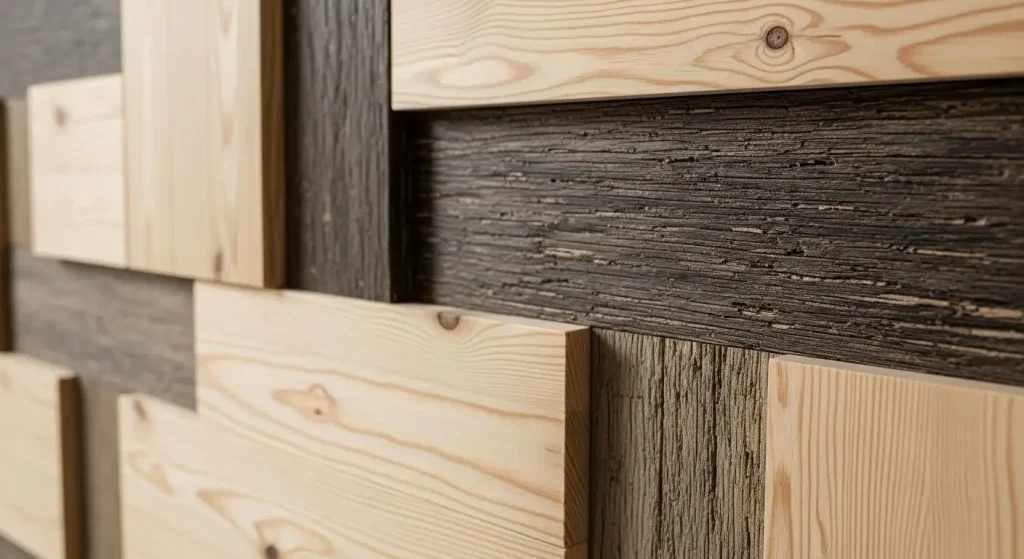
Wood Fiber Decorative Panels are engineered boards made from refined wood fibers, pressed and bonded to create stable, smooth, and often acoustically active surfaces. You will see them as plain, slotted, or micro-perforated panels for walls and ceilings. Many options accept veneer, lacquer, laminate, or paint. In practice, they solve three common needs at once: they quiet a room, they elevate the look, and they protect the substrate. For a first specification, think in families: high-density fiber panels for impact-resistant decorative cladding and acoustically tuned fiber panels (often perforated and backed with fleece or wool) for sound absorption.
Performance Targets to Specify in 2026
Clear performance targets keep bids comparable and risk low. Set acoustic, fire, and emissions criteria up front, and ask for accredited test reports in submittals.
Acoustic Benchmarks (NRC)
Noise Reduction Coefficient (NRC) indicates how much sound a surface absorbs. In typical independent lab testing of wood-fiber acoustic panels (ASTM C423/ISO 354), perforation pattern, thickness, and the presence of an air gap or mineral wool backing drive results.
• For offices, classrooms, hospitality: target NRC in the 0.70 - 0.90 range when using perforated panels with acoustic backing.
• For corridors and lobbies: NRC 0.50 - 0.65 can be adequate, often with shallower perforations or thinner backing.
• Practical tip: increase the air cavity (25 - 50 mm) or add a 25 - 50 mm mineral/wood fiber blanket behind panels to raise low-frequency absorption.
Fire and Emissions Standards
Most interior projects require proof of surface burning behavior and low formaldehyde emissions.
• ASTM E84: specify Class A for interior wall and ceiling finishes (Flame Spread Index ≤ 25; Smoke Developed Index ≤ 450). Confirm the test covers the full panel system, including finish and backing.
• TSCA Title VI (U.S.) or CARB Phase 2 equivalence: require compliance for composite wood. For reference, TSCA limits for MDF are 0.11 ppm (thin MDF 0.13 ppm) and 0.05 ppm for hardwood plywood; ask for a current compliance statement.
• EN 717-1 (EU): request E1 classification (≤ 0.124 mg/m³) or better for formaldehyde emission. If your project targets more stringent IAQ, ask for third-party VOC screening aligned with your region's program.
Dimensions, Density, and Finishes That Matter
Sizing and density influence appearance, handling, and performance. Decide these early, especially if you plan modular layouts or concealed fixing.
• Common module sizes: 600 × 600 mm, 600 × 1200 mm, 1200 × 2400/2440 mm; custom CNC formats are common for feature walls.
• Typical thickness: 9 - 12 mm for decorative cladding; 12 - 18 mm when perforated for acoustic absorption; thicker assemblies may be used over battens.
• Density guidance: choose based on use.
• High-density fiber panels (650 - 850 kg/m³) provide edge robustness, clean CNC routing, and crisp reveal definition.
• Acoustic assemblies using soft fiber cores (200 - 400 kg/m³) perform best with perforated faces to increase open area and absorption.
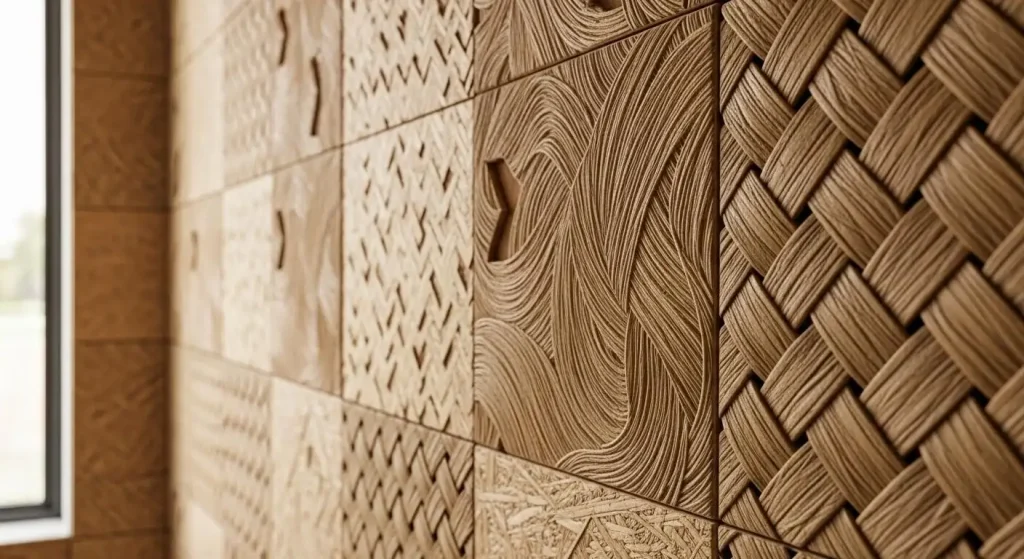
• Finishes: reconstituted veneer for consistent tone; high-pressure laminate for heavy wear; UV-cured factory paint for uniformity and hardness.
• Edges: square, eased radius, or bevel; matching edge finish eliminates dark joint lines.
• Fabrication tolerances: dimensions ±0.5 - 1.0 mm; thickness ±0.5 mm for consistent joints.
Installation and Tolerances: Avoid Surprises On-Site
Good installation is the difference between a premium surface and a fussy one. Build practical tolerances into the spec and brief the installer on moisture and sequencing.
• Condition panels on site for 48 hours in 40 - 60% RH, 18 - 27°C before installation. Wood fiber responds to humidity; acclimation limits movement.
• Substrate flatness: plan for ≤ 2 mm deviation over 2 m straightedge. Shim battens or use adjustable clips if walls are uneven.
• Fastening: concealed clips on battens provide clean lines and easy access for services. Where face-screwing is required, specify color-matched caps or factory-filled countersinks.
• Joints and reveals: hold panel-to-panel reveals consistent, typically 2 - 3 mm, with alignment within ±1 mm across a run. Provide 5 - 10 mm perimeter movement gaps, later covered by trim.
• Services and cutouts: route in the shop when possible. On site, use sharp carbide tools and dust extraction to protect finishes and maintain air quality.
• Maintenance: specify a low-gloss, repairable topcoat where touch-ups are expected; include a cleaning guide to preserve acoustic perforations.
Sustainability You Can Verify
Ask for the paperwork. Wood-fiber panels can meet your low-carbon and healthy-building goals when they come with third-party proof.
• Chain of custody: choose suppliers with FSC or PEFC chain-of-custody so you can demonstrate responsible forestry and earn applicable project points.
• EPD: an Environmental Product Declaration verified by a program operator provides quantified impacts (including global warming potential) per declared unit. Panels store biogenic carbon during service life; an EPD clarifies how that is accounted for.
• Indoor air quality: in addition to TSCA/EN 717-1, ask for VOC content of coatings and adhesives. Water-borne, low-VOC finishes help keep spaces healthier.
• End of life: choose hardware systems that allow panels to be removed, serviced, and reused; require finishes intended for refinishing to extend service life.
Your 2026 Specification Checklist + Next Steps
Use this concise checklist to set the Wood Fiber Decorative Panels scope and keep bidders aligned.
• Product description: interior decorative wood-fiber panels, with optional perforated acoustic type, factory finish.
• Acoustic performance: NRC target by space type (e.g., 0.70 - 0.90 for meeting rooms) with stated test standard and backing/cavity assumptions.
• Fire safety: ASTM E84 Class A for the complete panel system.
• Emissions: TSCA Title VI compliant (or CARB Phase 2 equivalent); EN 717-1 E1 or better for projects in Europe.
• Dimensions and density: module sizes, thickness, and density range matched to use (impact-resistant vs. acoustic).
• Finish and edges: veneer/laminate/paint color, sheen, and edge detail.
• Installation: fixing method, substrate flatness, acclimation, joint/reveal width, and on-site tolerances.
• Sustainability: FSC/PEFC chain-of-custody requirement and an EPD submittal.
• Submittals: physical samples, data sheets, accredited test reports, and care/maintenance guide.
• Quality assurance: mock-up area for approval before full install; final inspection criteria.
Call to Action: Ready to put performance on paper? Contact our technical team for certified test reports, detail drawings, and a spec template tailored to your project; we'll supply finish samples, NRC data for your target room types, and an installation guide with tolerances so your Wood Fiber Decorative Panels install cleanly and perform to your targets.


