



Contents
HSCS
Designing Exterior Wall Cladding for Qatar's Extreme Climate: Strategies for Survival and Sustainability
Introduction: The Ultimate Testing Ground for Building Envelopes
Qatar toughens up demand for the selection and application of Exterior Wall Cladding. On the Arabian Peninsula summer heat goes well beyond 45ºC. To add to that dry Shamal winds bring sand and the Persian Gulf contributes salt and humidity. Additionally, the relentless UV rays of the sun make the task of engineers and architects more challenging. The building envelope is more than an aesthetic statement; it is the first line of defense.
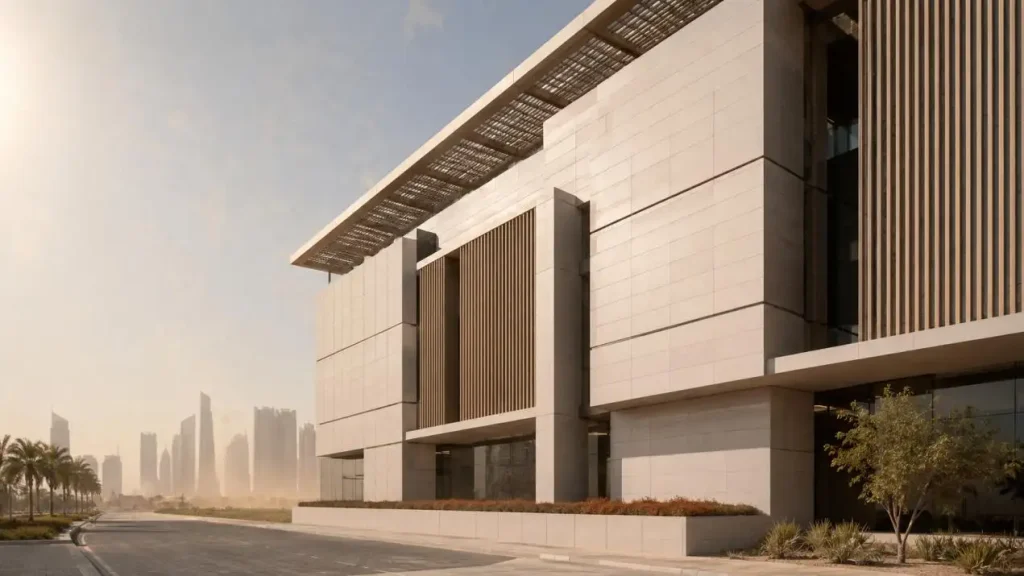
This article outlines advanced Research, Adaptive Climate technologies, and prominent design projects to highlight the functional and sustainable design strategies of Exterior Wall Cladding in Qatar.
The Climate Challenge: What Does Exterior Wall Cladding Endure?
In order to formulate design solutions the environmental challenges facing Building and Exterior Wall Cladding in Qatar must be understood.
•Extreme Heat: Sustained summer temperatures exceed 45ºC.
•Extreme UV Radiation: Cracking and fading result in the total loss of structural integrity.
•Salt-laden Humidity: Unprotected coastal air deteriorates building materials.
•Sand: Abrasive particulates get into systems and joints.
•Higher Wind Pressures: Open coastlines and dense high-rise buildings creates wind tunnels.
Using a combination of urban morphology changes with green infrastructures and cool materials, current research indicates the maximum air temperature in Doha could be reduced by 4.4°C, and the duration of extreme heat stress could be reduced by up to two hours. The findings are especially significant for regulating the design of Exterior Wall Cladding.
Strategy 1: Control of Solar Radiation and Heat
Arguably the most important role of Exterior Wall Cladding in Qatar is managing solar radiation. If no solar control is designed, direct sunlight increases the demand for air-conditioning to be deployed.
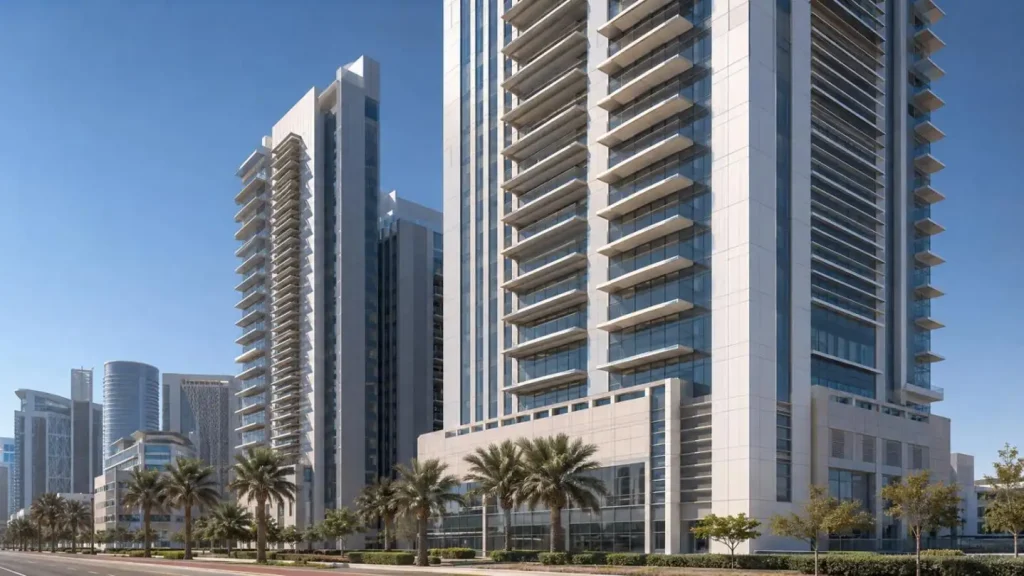
The Lusail Plaza Towers is a great example of this:
•The four towers designed by Foster + Partners, contain Design Solutions' precisely engineered, climate responsive elements of facade design.
•The bright, marine grade Aluminium cladding, have projections that shade the glass, which preserves the views and daylight, and significantly reduce the demand for air conditioning.
•The 301m towers also have sun shading that resembles gills, and reduces the demand of solar radiation control by 70% compared to a design that used glass.
The next stage is the Kinetic facade systems:
•The Lusail Plaza Tower facade systems, designed with BIM, achieved an energy use intensity of 203 kWh/m²/yr and is extremely close to the ASHRAE quantified goals.
•With the integration of photovoltaics, the systems could generate 6.8 million kWh per year.
•Climate responsive facades are an example of this, and can adapt geometry, transparency, and thermal properties in response to stimulus from the environment.
Strategy 2: Cool Materials and Radiative Technologies
Selecting the right materials for Exterior Wall Cladding in Qatar is crucial. Traditional materials tend to absorb and then re-emit solar radiation as heat, thus intensifying the urban heat island effect. Passive solutions using advanced cool materials can help.
A significant advancement is in radiative cooling paint:
•At Hamad Bin Khalifa University, self-cleaning, radiative paints are being developed with design goals to paint surfaces to have greater than 90% solar reflectance and thermal emissivity.
•These paints would reflect solar radiation and, with no external energy cost, effectively lower surface temperatures by radiating heat to outer space.
•Through superhydrophobic surfaces, self-cleaning is achieved, removing greater than 80% of the dust.
•Expected reductions in heat load and energy savings are between 20-30%.
Other cool material strategies consist of:
•Using low emissivity (Low-E) and solar reflectance coatings to minimize the intense solar heating and subsequently improve the air-conditioning energy demand is now the standard.
•Using advanced materials to produce thermally insulating panels also reduces heat transfer.
•Lastly, using light-colored materials and thicker walls impacts both energy use and the comfort of indoor spaces.
Strategy 3: Sand-Resilient Engineering
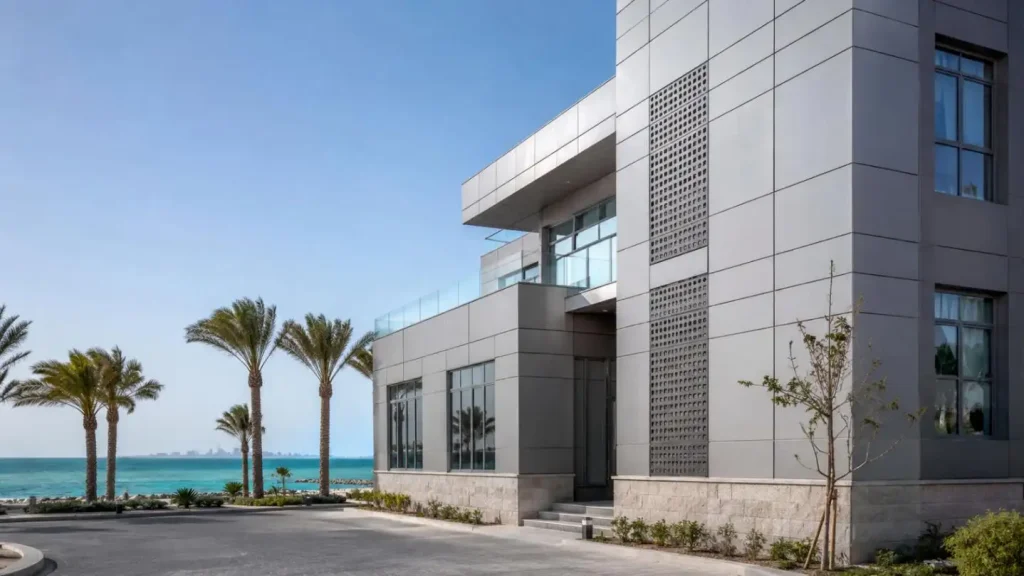
In Qatar, sand resilience is an essential design feature for Exterior Wall Cladding. Traditional facade systems experience sand infiltration that obstructs operable windows; failure of seals from UV exposure and heat, premature corrosion of metal, and panels deform from wind pressure.
Sand-resilient facade systems require:
•Advanced designs for pressure plates and gaskets to optimize sealing and limit sand intrusion.
•Gaskets made of EPDM that have high resistance to extreme temperatures and also high resilience.
•A material system that combines Gulf-grade powder coatings and silicone sealants that have ±50% movement capability and remain stable under UV exposure and heat.
•Marine-grade anti-corrosion coatings might include anodized aluminum and fluorocarbon coatings, employed alongside stainless steel fasteners.
•Effective drainage and cavity management to reduce moisture and temperature differentials.
Strategy 4: Biomimetic and Bio-Inspired Design
For thousands of years, nature has been dealing with the challenges of heat, light, and wind. It is, therefore, unsurprising that biological systems are often referenced in the Exterior Wall Cladding in Qatar.
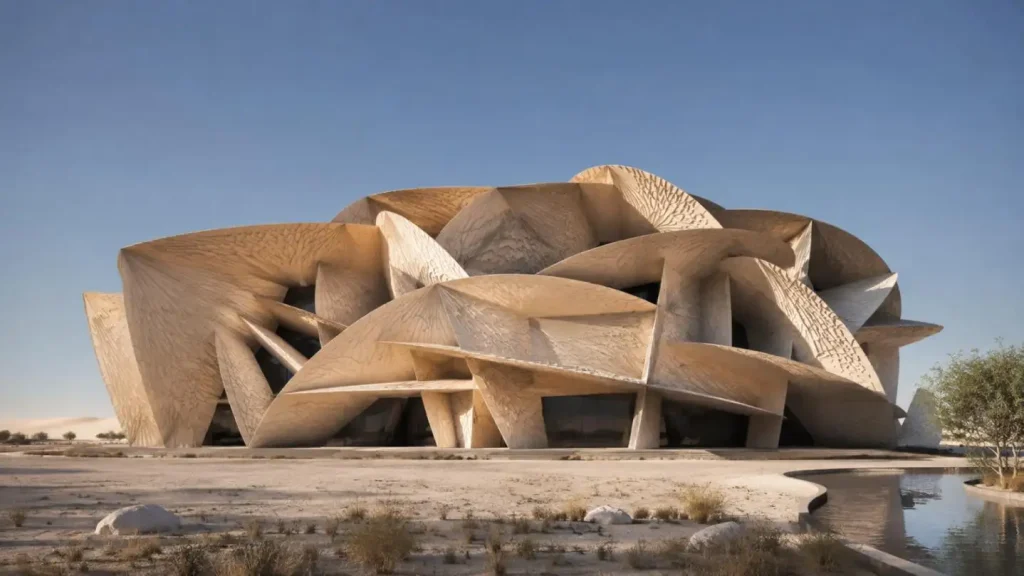
The National Museum of Qatar is a superb example:
•The museum, designed by Jean Nouvel, has an overall shape that is reminiscent of the Desert Rose, of which there are many examples in Qatar.
•The upper part of the facade, which has the appearance of the petals of the Desert Rose, shades the majority of the museum from the sun.
•Because of this, the museum's cooling requirements for the 1.5 million square feet of space are greatly reduced, and therefore its energy consumption is reduced.
•The panels of the facade are built of prefabricated UHPFRC and can be up to 3 meters long.
Biomimetic envelope design research is ongoing:
•An example is the 2024 study, which proposed a design for a nature-inspired building envelope for an office building in Doha, and the study analyzed the impacts of the nature-inspired design on cooling load and various daylighting metrics.
•The biomimetic design led to a greater improvement in energy efficiency.
•At Qatar University, there are live experiments on bio-facades for hot, dry climates that feature climbing plants and living walls.
Strategy 5: Double-Skin Facades and Ventilated Systems
As an innovative option for External Wall Cladding, Double-Skin Facades in Qatar establish a demarcation line between internal and external environments.
The benefits are presented below:
•The energy efficiency is higher when the intermediate zone is ventilated between two glass skins.
•For instance, double-skin, box-type window systems can cut cooling energy use by 16%.
•Passive solar shading devices positioned within the cavity can reduce solar gain by 40%.
•The cavity can contain natural, mechanical, or hybrid ventilation.
•Ventilated facades, modified from rain screen cladding systems typical of northern climates, facilitate airflow displacement by natural convection between the external cladding and inner walls—keeping the building cool.
Strategy 6: Green Infrastructure and Bio-Facades
In Qatar, Green Infrastructure is a new approach to Exterior Wall Cladding. Research has documented a significant cooling potential for the incorporation of vegetation in building envelopes.
The research on the mitigation of heat confirms the findings:
•A detailed study examined thirteen heat mitigation approaches for Doha, and included green infrastructure of extensive and intensive green roofs and facades.
•The combination of this strategy, intensive green roofs and facades, and a modification of the urban morphology and tree addition, resulted in a maximum temperature reduction of 4.4°C and a greater reduction of 24% in cooling energy demand.
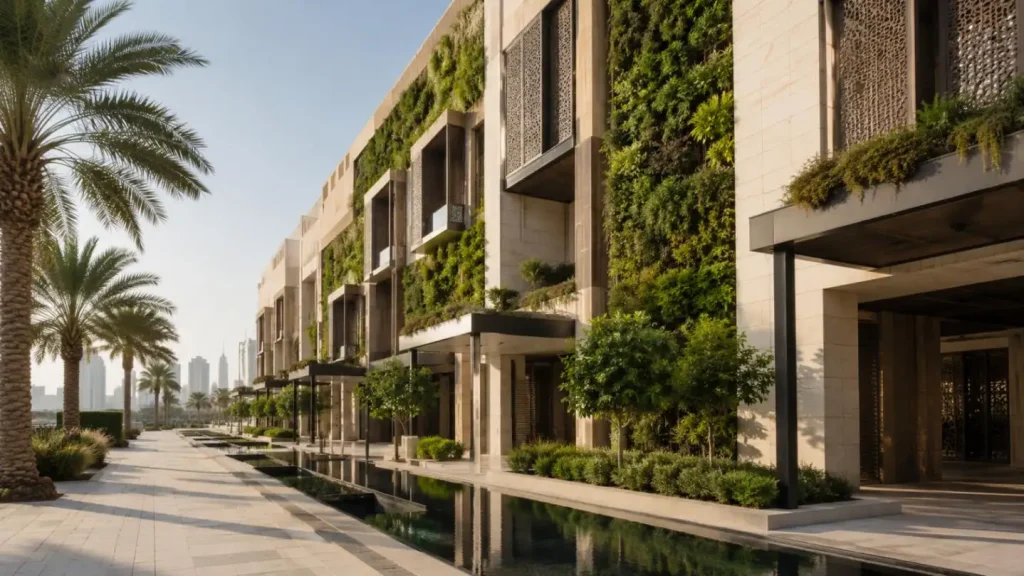
•Climate resilience and the improvement of the indoor environments is facilitated by the vertical greenery systems of green facades and living walls.
Smart bio-facades are in the design phase:
•Innovators of Qatar University are researching this wall system. The focus is a fully climate adapted design of a green wall system and smart biomaterials.
•Plant species appropriate for the region have been installed on the campus, and performance analysis will inform future plantings.
Strategy 7: Urban Morphology and Passive Design
Beyond the facade, the placement of buildings impacts the performance of Exterior Wall Cladding. Changes in urban morphology can produce self-shading microclimates.
The following are fundamental passive design approaches:
•Buildings are grouped to provide shade for one another to limit direct solar impact.
•Increasing the height of buildings can provide shade and help reduce the temperature at ground level.
•Deep facades on building perimeters provide solid appearance and excellent thermal mass.
•Arcades on ground levels create shade for users and pedestrians.
•Facades should be primarily designed to avoid solar gains at all times.
Strategy 8: Sustainability Certification and Performance Standards
Exterior Wall Cladding in Qatar has to meet demanding sustainability standards the Global Sustainability Assessment System (GSAS) among them.
GSAS considerations in facade design:
•The system, which has the endorsement of FIFA, aims to design a sustainable built environment with significantly less adverse impact on ecosystems of the built environment and with consideration for local environmental issues.
•Wall products made out of aluminum help in the compliance with GSAS with their material makeup, their thermal performance, and their sustainability throughout their life cycle.
•Aluminum panels which are fully or almost fully (60-70%) of post-consumer content and are fully recyclable help in providing points for sustainable sourcing.
The National Museum of Qatar received several awards, among them:
•GSAS 4-Star for design and build, which is the highest award in the category.
•LEED Gold.
•It is the only museum in the world to have received the awards for sustainability from several internationally accredited organizations.
Conclusion: The Future of Exterior Wall Cladding in Qatar
The Exterior Wall Cladding in Qatar has become a discipline in climate adaptive design, from biomimetic sunshades to kinetic facades. It has become world class as a result of Qatar National Vision 2030. The focus of future design strategies will be on passive, active, and nature-inspired design for sustainability. Weatherproof panels (HENGSU's ACP, fiber cement, metal) with UV, impact and fire resistance, insulation, and custom finishes can be integrated seamlessly in a demanding climate. Reach out to us for samples, to request technical support, and for competitive pricing.
FAQs
Q1: What impact does sand have on exterior wall cladding?
A: Damage is caused when sand scratches surfaces and clogs joints. The effects of sand are reduced when cladding has a smooth, sealed finish with a self-cleaning coating.
Q2: Does cladding in Qatar require a fire rating?
A: Yes. Class B1 or higher is required for ACP, and building codes require fire-retardant materials for high-rise building facades.
Q3: Can designs that feature mashrabiya be integrated with modern cladding?
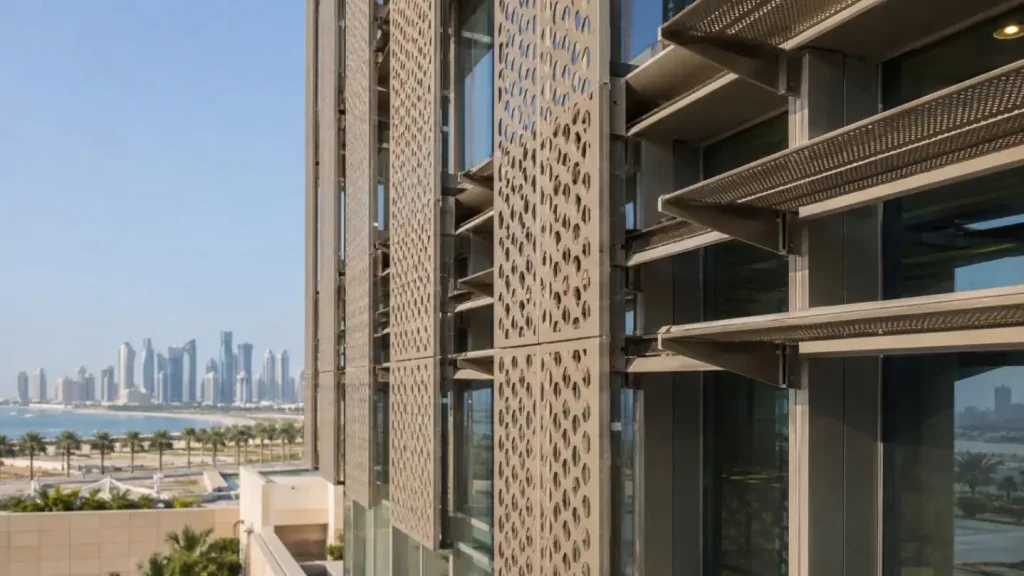
A: Yes. Designs for solar shading that feature mashrabiya have been made using either perforated metal screens or 3D aluminum panels.
Q4: Does cladding reduce the cost of air conditioning?
A: Yes. Systems that employ insulated cladding and ventilated facades reduce the cost of cooling by approximately 30% due to the lower rate of heat transfer.
Q5: What are the required certifications for cladding materials in Qatar?
A: Certifications for GSAS, LEED, and fire safety to EN 13501 or local approvals from the Civil Defence are required.


