



Contents
HSCS
Fire-Resistant Wall Cladding: What It Is, How It Works, and How to Choose the Right System
The building envelope design has now made fire safety a core requirement that directly influences the regulatory approvals, insurance requirements, and risk management over the long term.The significance of fire-resistant wall cladding is significant since facades may serve as routes of upward and sideways traveling of flames and hot gases in case of openings, insulation, and joints permitting the spread of heat and fire.
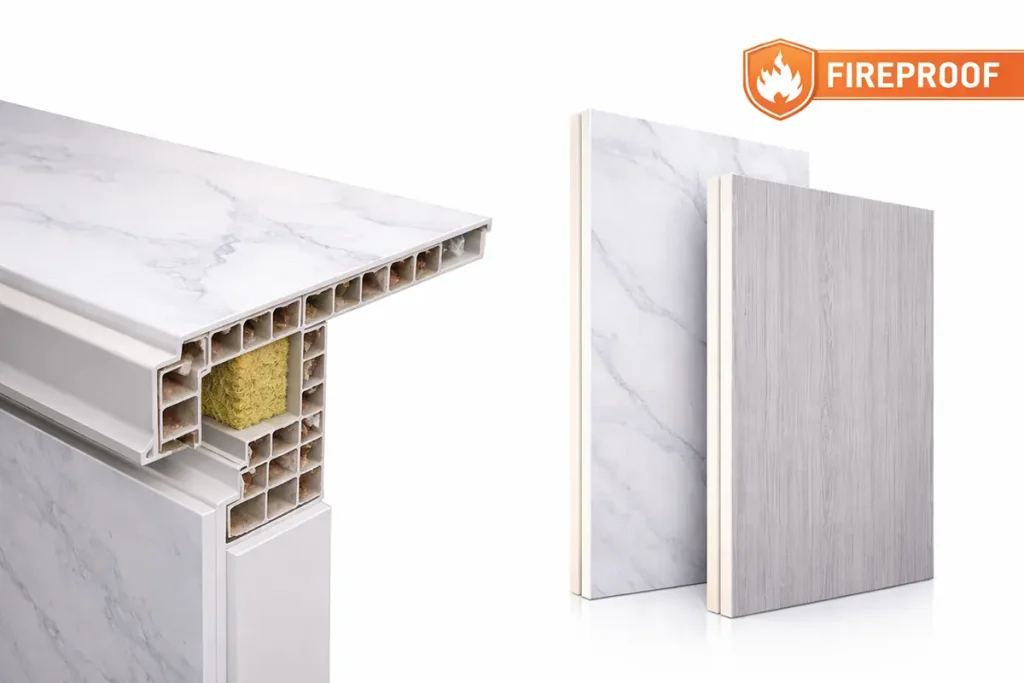
This paper describes what constitutes fire-resistant wall cladding, what constitutes the good performance of a cladding system in the case of a fire and how a specifier can have fewer surprises on the job.
1) The meaning of fire resistant cladding
The most mistaken idea is that fire performance is merely regarding the outer panel. As a matter of fact, fire behaviour of a facade is determined by the entire system:
- Cladding panel
- Subframe / rails / brackets
- Insulation
- Membrane / weather barrier
- Strategy of cavity ventilation and control of airflow
- Fasteners, sealants and jointing tapes that are mechanical
- Fire prevention systems and barrier systems to cavity
- Finishing windows, doors and edges of slabs
A panel may be sold as never to be combustible, however placed over combustable insulation, or in front of a very flammable membrane, without adequate cavity shields, the facade, even though properly detailed, may fail dismally in a real fire.
When determining fire resistance therefore, consider the system design and not just the product brochur only.
2) How facade fires may be aggravated by the presence of cladding systems
Facade fire events tend to get out of control due to a combination of one of more of the following conditions:
Ventilated cavities
The rainscreen facades are designed to have an air gap to aid in drainage and drying. However, when there is a fire, such a cavity may act as a chimney, increasing the speed of spread of the flames (the stack effect) unless stopped by specially designed cavity barriers.
Combustibles and constituents of the system
There are those composite panels that have polymer cores. When subjected to high temperatures, they may melt, drip or produce flammable gases that further expand fire development and smoke.
Weak and open joints and weak detailing
Joints, corners, and windows, and slab edges can have gaps that may permit the fire to penetrate the cavity.
Incompatible selection of membranes and tapes
Some membranes and joint tapes are capable of catching fire and spreading it regardless of the panel being more fire resistant.
The control of these pathways is fire resistance.
3) Terminology used in fire performance
You will find such terms as: when describing fire resistant wall cladding:
Nonexistent / restricted combustibility
Frequently applied to the material, which is a mineral-based board, fiber cement, stone, and metals. Various codes and tests have different definitions.
Reaction to fire
The role played by a product in the development of a fire (ignition, release of heat, spread of flames, smoke, dripping).
Integrity and insulation of fire resistance
The duration with which an assembly can withstand the exposure of fire and reduce heat transfer. The term is more frequently used on the fire-rated walls as opposed to rainscreen cladding, but it might also be used on some facade designs.
System fire testing
Large scale facade tests are an evaluation of the whole cladding system under the exposure to fire. Lots of jurisdictions do not accept evidence of individual material ratings but only evidence of recognized system tests.
When a supplier is supplying a small material certificate, that may not be sufficient to get approvals where system testing is supposed to take place.
4) Fire-resistant cladding material is usually made with the following materials
The following are common cladding choices related to higher fire performance- installation system and final suitability will be determined with regard to the specific product used.
Materials of sheet and panel metal cladding
Metal panels burn not, however, a number of factors is still taken into consideration:
- TCurt superficial metal is heat deformable
- Smoke and flame qualities are susceptible to coating and paints
- The insulation and the membrane layers that are located behind the metal panels are crucial to the fire performance
Fiber cement panels
They are popular in mid-rise and high-rise buildings in which the fire performance is not problematic and the service life is needed to be long and stable in dimensions.
Board made of minerals (e.g., calcium silicate / other types of such boards)
Applied in areas where there are stringent non-combustibility specifications. They might be heavier and require attention and adequate subframe design.
Stone, porcelain and ceramic systems
They provide excellent fire-resistant (non-combustible) operational and exceptional appearance, but typically require special repair systems and serious load estimation.
Composite panels made of special cores and fireproof
Other composite panels have mineral enriched or fire retardant cores that are less easy to burn than polymer cores. They may be a possibility with the correct approvals and tested systems however, not all buildings are suitable with core FR, which is why it is not necessarily core FR.
5) The considerably underestimated aspect: insulation and layers of membranes
With a facade that fails fire objectives, you can still pass fire objectives on where you just upgrade the panel and leave combustible layers behind the panel.
In case of a higher-risk building, the designers tend to focus on:
- Mineral wool insulation (non-combustible, it does not suffer during high temperatures)
- Fire rated membranes which comply with local code standards
- Non-combustible subframes to be used, or approved fire protection to support structure to be implemented where necessary
This is usually where the budgets flow most as fire performance is provided by the whole assembly- not one product.
6) Cavity barriers and fire stopping: where systems succeed or fail
Properly created cavity barriers are the difference between acceptable fire behavior and potential extreme rapid fire propagation in the ventilated facade systems. Barriers are generally involved with good practice at:
- Every floor slab edge
- Around windows and doors
- At compartment lines
- Where facades meet and intersect
- In the bottom and the top of cavities
These barriers should not conflict with the ventilation plan, some are created to permit airflow under normal operating conditions but swell and close during a fire (intumescent solutions).
The quality of the installation is equally important like the design. There has to be a minimal constant disconnect in a workflow.
7) Fire-resistant cladding specification plan
To reduce the number of delays and substitutions in the process of construction, construct your specification based on evidence and detail control:
1、Verify the classification and regulatory compliance route of the fire-risk of the project
The minimum fire requirements are motivated by height, occupancy, evacuation plan and local regulations.
2、Order complete system test reports of facade where needed
It is better to have a record of the entire build-up: panel + insulation + cavity + membrane + subframe.
3、Stipulate non-combustible insulation or insulation that meets the fire regulations
Insulation is an item that must not be left unspecified as a rule.
4、Definitely outline the location, type and installation requirements of cavity barriers
Supply cavity-barrier layout drawings and necessary spacing /intervals and list of either approved barrier systems..
5、provide elaborate junctions at the edge of slabs and window/door outline
These are the most prevalent areas of failures.
6、Assurances and attachments
Polymer material, gaskets, and thermal isolators can have to be selected and verified as fire-compliant.
7、Make certain that the warranty does not come into conflict with safety description
Where the warranty conditions require limitations on the penetrations or choice of sealants, the same should be resolved early in the design so as to avoid the approval and warranty problems in the future.
8) Contractor/ installer best practice
The best specification will not be effective in case the site performance is poor. Examples of real-life actions that will improve on-site performance:
- Use one acceptable facade build-up (not to be no review substitutions of value engineering)
- Security install panels and cavity barriers with a tight fit and solid contact, and little spaces between them may compromise fire and weather performance
- Maintain cavity cleanliness because the materials that may accumulate may add to fire load
- Light fire-stopping at the time before closing the facade
- Make sure that the inspection is signed on important phases (slab edge barriers, around openings)
Inference: It is a system choice and not panel choice to use fireproofing cladding
The wall cladding is fire resistant, but this is not about what a panel is composed of being better than the others, rather it is about the behavior of that facade when extreme heat occurs.The best approach to a fire-safety performance is an integrated system approach of combining compliant parts, documented test performance, a duly detailed cavity barriers, and a firm control of the installation.
When choosing cladding on a building that has a greater risk, or just wish to have less liability and greater confidence in approval, it is best to define the performance target, and then clarify the entire assembly with documentation to match.


