



Contents
HSCS
Textured Wall Cladding Panels: How to Choose Texture, Depth and Lighting for Real Interiors
An impressive textured wall can be completely different when it covers a 5-meter wide wall.
It's simple, there is a reason: Texture is not just a surface finish. This will be influenced by the depth of the reliefs, the scale of the pattern, the distance of the viewing, the size of the wall and the direction of the light source.
This means that the choice of textured wall cladding panels can be seen more as an architectural choice and less a colour choice.
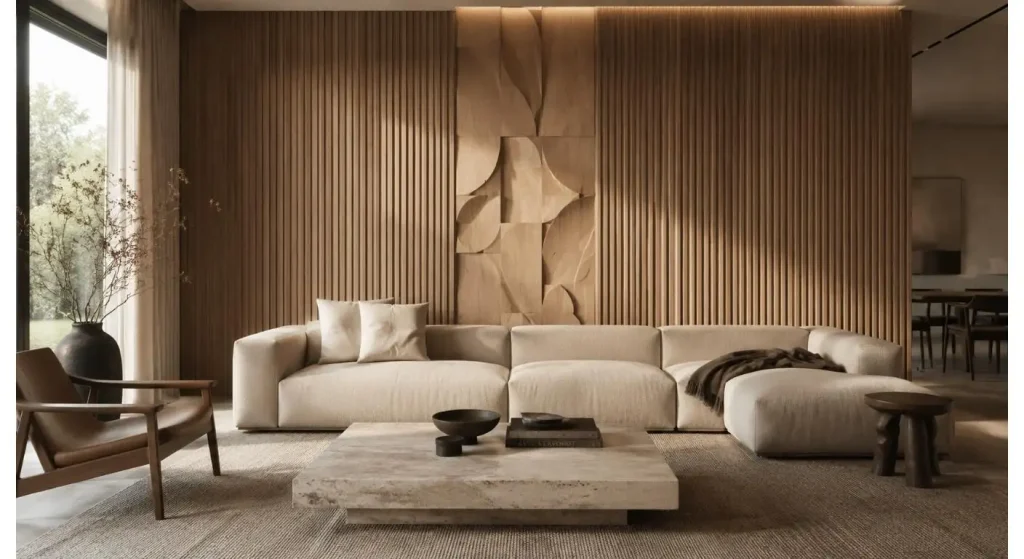
The question for designers and contractors – and project buyers – is not “Which texture looks best?” It is “Which texture will still look good if it is repeated out onto the actual wall?”
Texture is really a Light and Scale Choice
The sample is 20cm long, and is observed from a distance less than one metre. This wall in a hotel lobby can be seen from 5 or 10 meters away.
In your hands they might seem like fine grooves but from a distance they may not be visible. In deep waves or geometric reliefs more shadows are created and they can be seen over greater distances.
That's why the depth of the texture should depend on the distance the viewer is from:
Smaller rooms and for close viewing, use "fine" flutes.
Medium grooves to add architectural rhythm, but not overpower a room.
In the case where the wall needs to stand out from a distance, deep waves and geometric reliefs are suitable options.
Low relief wood grain provides surface interest without creating a focal point on the wall.
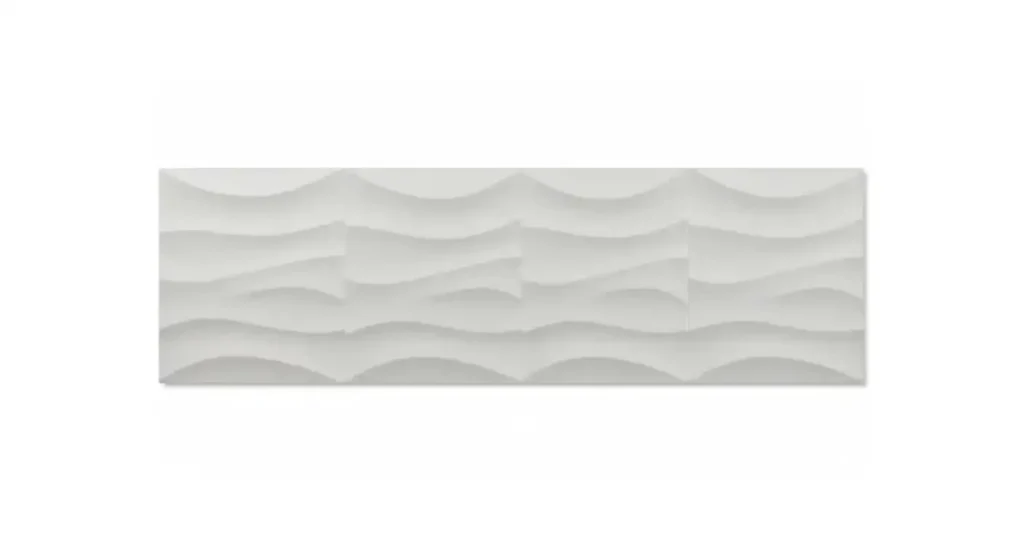
The 3D wall cladding panels from HSCSDECOR feature sculptural wave and geometric surfaces, which vividly demonstrate the influence of relief details on the wall and the effects of light.
Kick off With the Surface Effect that You Need
There are a number of quite distinct design language under the umbrella of “textured”.
Fluted and slatted profiles produce multiple shadow lines that are all either vertical or horizontal. They are especially effective in places where the designer desires to create the impression of visual elevation, rhythm or a warm, inviting architecture.
Wave and ripple profile to help make the shadows softer. They don't create a hard grid, they create a more fluid feature surface.
The wall is a strong design element, with geometric 3D profiles. They tend to work very well in reception areas, retail walls and in large statement surfaces.
Embossed wood-grain surfaces don't depend on the depth of the profile, but on the appearance of the material. They can come in handy where texture needs to complement and not overpower.
What matters is that it's the visual function that is picked first, and then the product is picked that will make the visual function.
| Texture Profile | Visual Effect | Best Viewing Range | Typical Application | Main Design Risk |
| Fine Fluted | Subtle linear shadow | Close–Medium | Bedrooms, Offices, Corridors | Texture may disappear from distance |
| Wide Slat | Strong architectural rhythm | Medium | Media Walls, Reception Areas | Joint alignment |
| Wave / Ripple | Soft sculptural shadow | Medium–Long | Feature Walls, Lounges | Can look busy under strong light |
| Geometric 3D | Bold depth and contrast | Medium–Long | Hotels, Retail, Lobbies | Pattern repetition |
| Embossed Wood Grain | Natural material texture | Close–Medium | Residential, Hospitality | Grain consistency |
Select the Material following the Texture
Even though two panels might have the same pattern, they could have different material and construction and therefore have different behaviors.
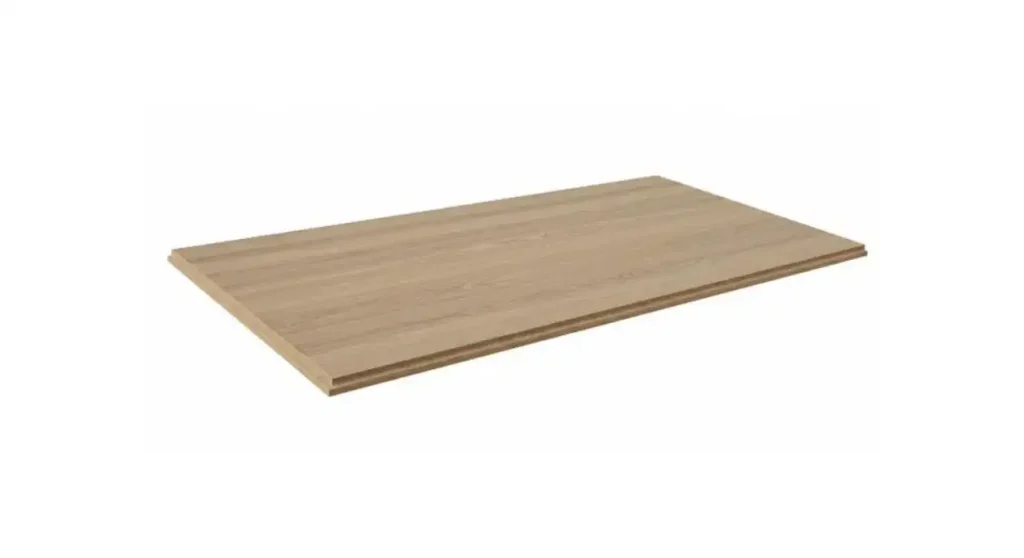
WPC wall panel interior products are suitable for interior projects in cases where customers desire to have a wood-like surface and at the same time reject getting wet and easily installing the panels. HSCSDECOR also provides various other inside uses by combining various other shades, textures and finishes.
This gives a different feel to the wall panel, which is made of solid wood. The different natural wood grain and slit profiles create warm material variations and the repeated slit pattern creates architectural rhythm.
Still other profiles and finishes can be achieved on PVC, MDF, gypsum and the other decorative panel materials.
Be sure to not use “3D texture” first and material later. Discuss together what the appearance should be, how it should be cleaned, the type of substrate used and how it should be installed.
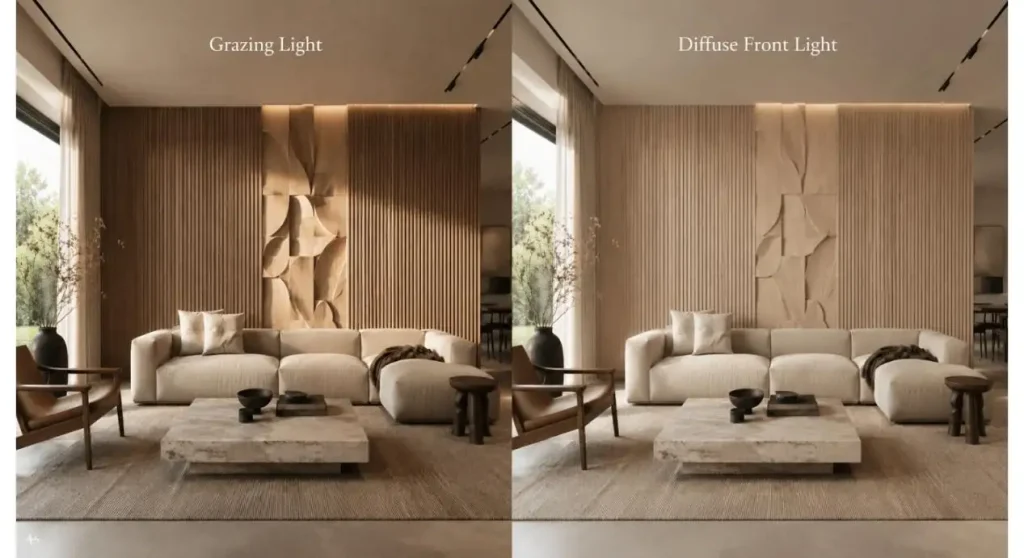
Textured Wall Cladding Panels can be enhanced and even overwhelmed with lighting.
Same panel with diffuse frontal lighting can look nearly flat and sculpted with side lighting.
Grazing light falls along ridges, rather than directly on them. This will result in alternate highlights and shadows that will show the depth of the profile.
This indicates that lighting should be taken into consideration when approving samples.
A practical examination should consist of:
- Instead of the true direction of the room;
- Ceiling or wall washing lights;
- Sidelight or grazing light;
- The lighting condition that is expected during the night.
Under strong side light very deep textures can become "busy" to the eye. Flat lighting can negate most of the effect of fine profiles.
A good sample approval will thus consider panel + light; not panel alone.
Repeatability throughout the entire wall is the Most Overlooked Issue.
Single panels can be perfect and the wall can not.
| Sample Check | What to Test |
| Viewing Distance | Review at approximately 1 m, 3 m and normal room distance |
| Daylight | Observe morning/afternoon light direction |
| Artificial Lighting | Test frontal and side lighting |
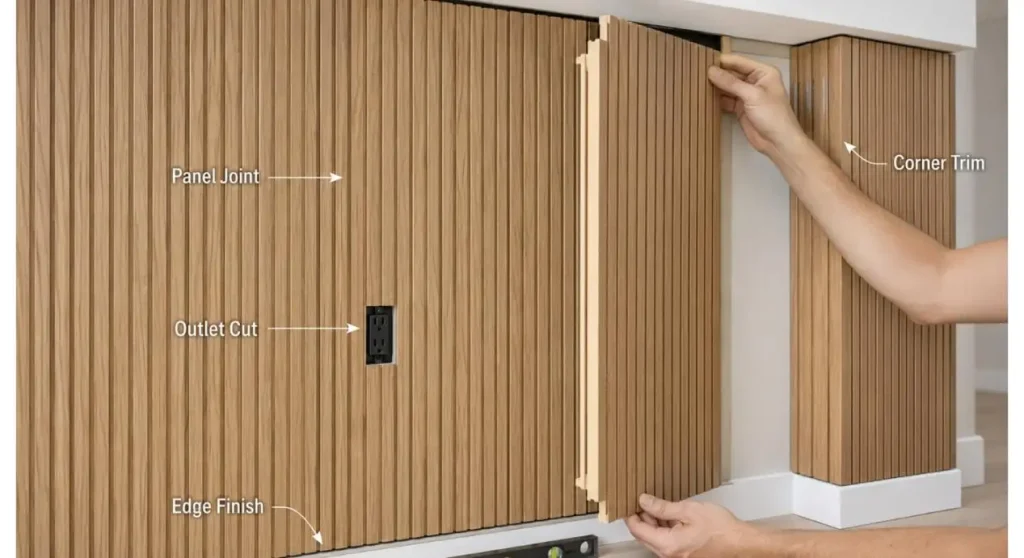
| Panel Joint | Install at least 2–3 panels together |
| Corner Detail | Test internal/external corner treatment |
| Cleaning | Wipe and brush the deepest grooves |
| Openings | Mock up one outlet or switch cut-out |
| Finish Consistency | Compare several panels from the same production batch |
When dozens of textured wall cladding panels are used together, continuity of a pattern is important. Buyers are advised to check for connections between panels.
Check:
- Whether or not there are grooves that extend seamlessly from joint to joint;
- if the motifs are repeated then become apparent;
- how the outside and inside of corners are detailed;
- How the texture ends at ceilings and floors;
- If outlets and switches break significant pattern lines or not;
- If the adjacent panels are in the same tone and finish.
If you want to install a large feature wall, it is better to find out how it looks in a mock-up of several panels rather than just one.
The texture of the soil should be affected by maintenance.
The deeper the texture, the more impact it will have but it will also have more areas where dust can collect.
This is more crucial in hospitality and retail environments as well as corridors and other areas that are cleaned regularly. HSCSDECOR's maintenance instructions for fluted and 3D WPC panels state that, in some cases, a soft brush will be necessary as a flat cloth may not be able to access recessed areas.
If you are using this for a residential feature wall, it may be okay to have detailed cleaning occasionally. A shallow profile or grooves that can be easily accessed can lessen maintenance for a commercial wall receiving a lot of traffic.
For projects like reception spaces, reception wall cladding panels are also similar to HSCSDECOR's hotel lobby wall cladding panels, which must be impact resistant, easily cleaned and commercially used.
Indicate Wall but not Just the Panel
When ordering the textured wall cladding panels, you should have a description of the finished wall.
Note the dimensions of the wall, the distance from which the wall will be viewed, the general direction of the light, the amount of light traffic, the substrate, corner treatment and the location of switches or outlets.
Afterwards test a sample or mock-up under conditions that simulate the final installation.
When installing a WPC panel, it is important to have a good understanding of cutting, joints and maintenance prior to installation so that a good panel will not lead to a poor finished wall. HSCSDECOR also offers a simple guideline for the cleaning and maintenance of WPCs wall panels.
Final Selection Check
No one texture depth is best for all projects.
The specification which is successful is the one where:
- the texture is easily observed at the normal viewing distance;
- the amount of shadow created by the lighting is desired; and
- The material is compatible with the environment;
- There's no disruption of the design with panel joints;
- The corners and openings are envisaged;
- maintenance remains practical.
The best textured wall cladding panels are not therefore the panels which are the deepest in the pattern.
These are the panels that still function when the sample is an actual wall.
FAQ
Q1 .What are Textured Wall Cladding Panels?
They are embellishment wall panels that feature embossed surface patterns, grooved, slatted, wave or three-dimensional patterns. They are used to give an otherwise flat wall depth and shadow effects, as well as material qualities.
Q2. But is it always better to have a deep texture as opposed to a shallow one?
Not at all - deep relief will produce more effective shadows, shallow textures are typically quieter looking, and possibly easier to maintain.
Q3. What are ideal textured panels for big commercial walls?
Medium to deep profiles typically are more visible from longer viewing distances. Lighting, traffic, continuity of cleaning and panel-joints should also be taken into account in the final decision.
Q4. Are there any wall cladding panels that can be used in interiors with dampness?
Yes, provided that the moisture level is acceptable and the material and panel construction chosen are suitable. Do not take the moisture performance for granted for all decorative panels—confirm manufacturer's use.
Q5. Is it recommended to test lighting first, before deciding on a texture?
Yes. The same surface can be dramatically caught in relief with the side lighting and look better with frontal diffuse lighting.


