



Contents
HSCS
Exterior PVC Siding Panels: What to Check Before Choosing a System
Exterior PVC siding panels can provide a fresh, low maintenance appearance and lessen painting of the timber or rendering of surfaces. But the word “PVC” is not enough to decide whether they are suitable or not.
A panel designed for an interior wall may not be able to withstand the sunlight, temperature variation, wind or exterior fixing conditions. Therefore, it is advisable for the developers, contractors and importers to assess the material, profile, accessories and wall assembly as an assembly, before approving an order.
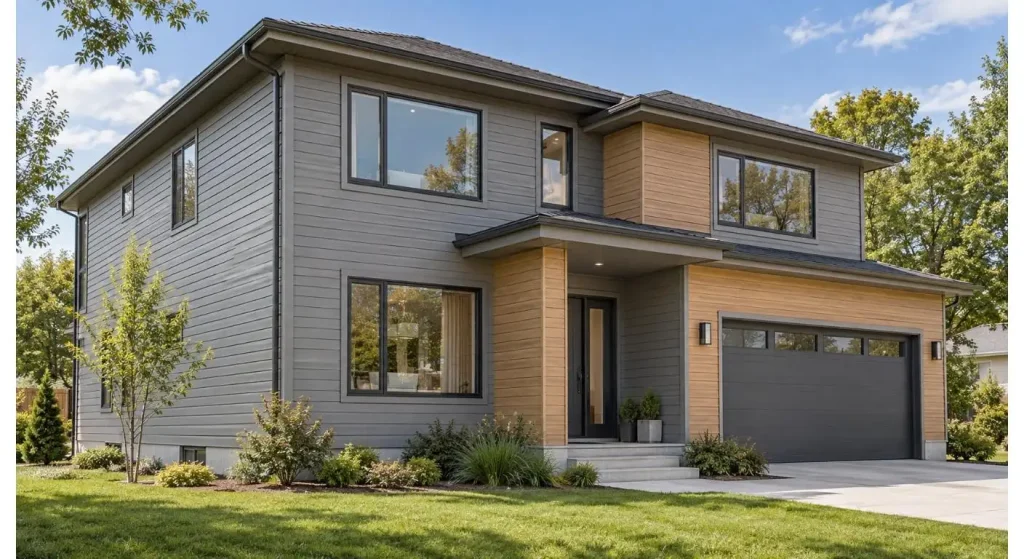
Exterior PVC Siding is much more than a decorative panel.
The exterior siding is the part of the building envelope that is seen outside the building. It is necessary to control the exposure, but the drainage and drying of the wall behind it must be provided as per the project design.
The PVC siding panels can be of solid, hollow, cellular or co-extruded. Not all of these profiles are the same in terms of stiffness, shock resistance or heat resistance. Printed finishes or surface films may also react differently to the sun and weathering.
HSCS Decor's range of plastic PVC wall panels is available for customers to view, giving them an idea of the general form of the PVC panels they can use on their exterior walls, but the exterior use must be confirmed separately with the model chosen.
Make sure that the panel is classified as an outdoor rated item.
A panel may not be used for an outside application because of its water resistance. Additionally, exterior products might require proven UV stability, dimensional stability, impact resistance, fastening strength and performance over the temperature range of the project.
Request the supplier to write the application. The name of the product and the model on the specifications, quotations and samples, as well as on the available test documents, should be the same.
If an outdoor suitability cannot be shown, then consider to use a material which is specifically presented as an exterior for facades. The exterior WPC wall panel offering are a proper comparison for outdoor wall panel jobs.
The building should match the Panel.
The conditions at an entrance that is sheltered and the conditions at an upper level wall that faces the sun are different. Establish exposure areas and then select a single specification for the entire building.
Take into account the direction of the sun, the rainfall, wind pressure, salt air, freeze-thaw and the potential for ground level impact. More heat absorbed by dark finishes than light colors, resulting in higher panel temperature and movement.
Some projects, including those that are high rise, located on a coast or storm exposed property can need engineering input beyond the product installation guidance. Always select the products in order to meet the applicable local building requirements.
| Elevation Zone | Main Exposure | Evidence to Request |
| South-facing wall | Heat and strong sunlight | UV and color-stability data |
| Ground floor | Impact and splash water | Impact and moisture data |
| Coastal façade | Salt, wind and humidity | Exposure suitability statement |
| Cold-climate wall | Low temperature and freeze-thaw | Temperature-range data |
| Sheltered entrance | Lower weather exposure | Standard exterior specification |
Provide for Thermal Expansion and Contraction
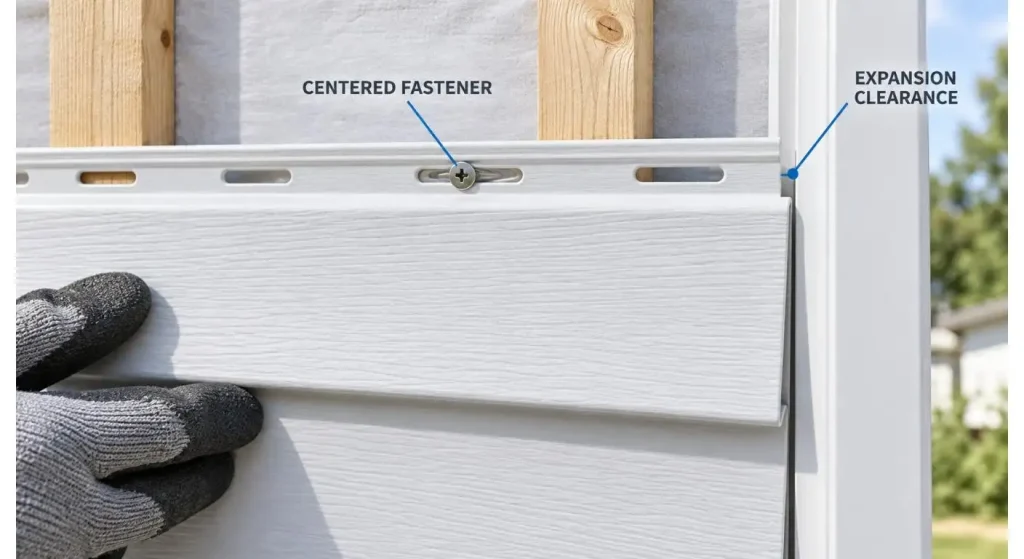
The temperature of PVC causes it to lengthen and shorten. Panels which are not installed with an adequate end clearance or which are installed too tightly may buckle, distort or come apart at the joints.
Always follow the confirmed fastening pattern and profile expansion for the particular profile. Panel should be fastened so that it can move as specified, yet be held firmly. Installers shouldn't replicate spacing information from a different siding product.
The following are some special points that need to be paid special attention to: long elevations; dark colors; large temperature differences. Write down the installation temperature since it influences the clearance for expansion and contraction later.
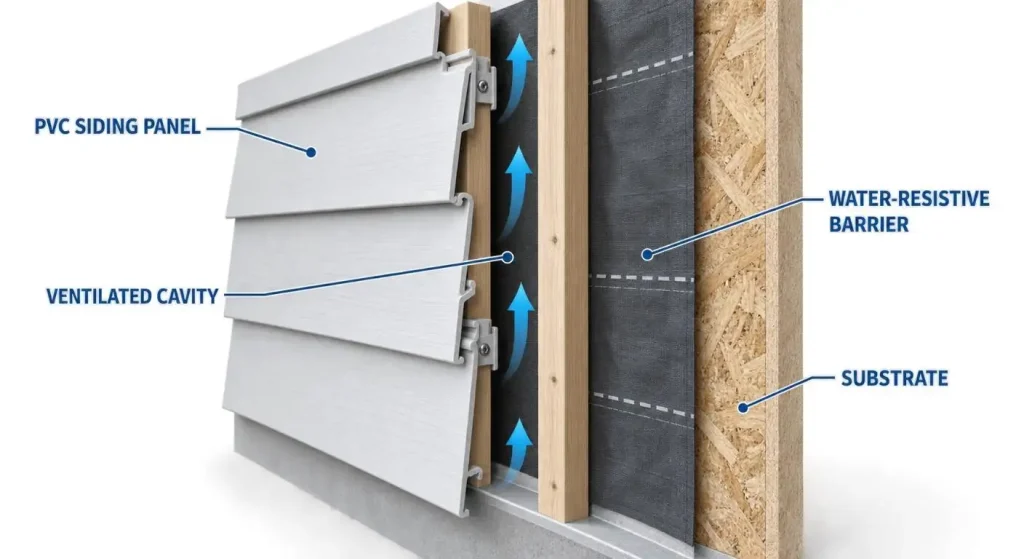
Design Drainage and Ventilation for Behind the Panels.
PVC siding outside the building cannot be considered the only water control layer. Rain can enter through joints and corners, openings or damaged areas.
This water should be channeled outwards by the wall assembly. This can include water-resistive barrier, flashing, drainage cavity, battens and ventilation openings depending on the system and the local construction technique.
Ensure good drainage routes to the base of the wall. Moisture can collect behind water-resistant panels due to improper use of sealants or outlets that are blocked.
Solve Corners, Openings and Transitions.
Most façade issues are not on a main wall area but in detail. Check the elements of the interior and exterior angles, edges, intersections, windows, doors, and material joints.
The accessory dimensions should be appropriate for the panel thickness and motion requirements. Combining cuts from other systems can result in poor connectivity or limitations for expansion.
Prior to ordering, make elevation drawings and an accessory schedule. The wider wall cladding panel category offered by HSCS Decor can assist customers in determining the various profiles and directions of finishes available.
| Façade Detail | Measurement Needed | Order Item |
| External corners | Total vertical length | External corner trims |
| Internal corners | Total vertical length | Internal corner trims |
| Windows and doors | Opening perimeter | Edge or reveal profiles |
| Wall base | Total starting length | Starter or base profiles |
| Material transitions | Joint length | Transition profiles |
Check exterior mock-up for approval of colors.
Test sample conditions outside as well as under showroom lights, to gauge production-representative conditions. View under different lighting conditions in direct sunlight, shaded and at normal viewing distance.
A mockup of a small facade will provide information on the visibility of the joints, levelness of the panels, corner treatment, the marks used for fastening, and the relationship between the horizontal and vertical lines. It also provides an installers reference prior to completion.
Acceptable batch variation and batch allocation for large elevations to confirm. Keeping spare panels of the same date of manufacture may make it easier to repair in the future.
Ensure that the documentation is checked prior to purchase.
Ask for pending specific sheets of documentation to be provided, including installation instructions and test data for the target market and promised performance. The first step in reviewing documents is to get started with HSCS Decor's certification section.
A general company certificate does not necessarily establish all the exterior claims. Look at tested model, specimen construction, result, standard and issuing laboratory.
The buyer should also confirm: Packaging, Labels, carton quantities, panel coverage, Storage requirements, Shipment protection.
Calculate the order of a complete system.
Use actual coverage, not nominal width to determine panel quantities. Include allowances for cuts, alignment, openings, corners and installation waste.
Separately list trims, battens, fasteners and other accessories. Even if you are shipping the correct number of panels, you may be waiting for panels with a smaller number of corner profiles to complete the project.If you have the right panels, but not all of the corner profiles, the project can be delayed.
If a new system, start on a mock-up or limited system if possible. Apply the outcome to complete the gaps in expansion, finalise fixing techniques and standards of workmanship prior to the release of the full order.
Conclusion
PVC siding panels on the exterior should be chosen in conjunction with the other components of a façade assembly and not just as a decorative piece. Performance is impacted by outdoor rating, thermal movement, drainage, accessories and installation information.
Prior to requesting a final quotation, the Buyer should give the Contractor exposure information and drawings of the project. For more information about wall cladding materials, samples and project requirements please reach out to HSCS Decor.
FAQs
Q1. Is it okay to use all PVC wall panels for exterior applications?
Interior PVC panels might not have the UV stability, structural characteristics or heat resistance needed to withstand outdoor conditions. Verify exterior suitability for specific product model.
Q2. Do PVC siding panels on the outside of the house repel water?
PVC is waterproof, but can still permit water to enter through joints and openings behind the siding. The complete wall assembly must have the proper drainage and weather-control layers.
Q3. Do PVC siding panels get bigger in hot weather?
Yes. PVC changes size due to temperature changes. To avoid buckling need correct fastening and correct design and end clearance.
Q4. Exterior PVC panels can be installed over an existing wall?
Only when the substrate is stable and the proposed assembly is able to meet the drainage, ventilation and fixing requirements. If there is an uneven or damp substrate, this needs to be fixed first.
Q5. Should Spare Siding Panels be ordered?
Yes. The use of spare panels from the same batch will minimize the chance of visible color differences and minimize installation damage and future repairs.


