



Contents
HSCS
WPC Wall Panels vs. Wood Panels: A Real-World Comparison (2026 Guide)
While solid wood wall panels offer timeless beauty, they come with a "maintenance debt" that many homeowners overlook. At HSCS Decor, having manufactured and installed over 50,000 square feet of wall cladding in the last 20 years, we’ve seen firsthand how traditional wood ages compared to modern WPC (Wood Plastic Composite). This isn't just a spec-sheet comparison; it's a reality check on what it’s actually like to live with both materials.
The "Cheat Sheet" Comparison
WPC wall panels generally outperform solid wood in moisture resistance, installation speed, and long-term cost, while wood wins on "touch warmth" and perceived luxury. WPC is the superior choice for high-humidity areas like bathrooms, whereas wood is best reserved for climate-controlled dry areas.
For a quick decision, we’ve compiled our factory testing data into this comparison matrix:
| Feature | WPC Wall Panel (HSCS) | Solid Wood Panel | Winner |
| Moisture Resistance | 100% Waterproof (Non-porous) | Hygroscopic (Absorbs water/swells) | WPC |
| Installation Speed | Fast (Interlocking Clips) | Slow (Glue, Nail, Sand, Varnish) | WPC |
| Maintenance Cost (5 Yrs) | Near Zero (Soap & Water) | High (Varnish/Termite Treatment) | WPC |
| Aesthetic Warmth | High (3D Embossed Grain) | Very High (Natural Irregularity) | Wood |
| Scratch Resistance | High (Dense Polymer Surface) | Low-Medium (Dents easily) | WPC |
| Fire Safety | Class B1 (Self-Extinguishing) | Flammable (Unless treated) | WPC |
1. Aesthetic & Texture: Can You Tell the Difference?
Modern WPC panels use 3D embossing technology to mimic the grain depth of real timber, making them visually indistinguishable from wood at a distance of 2 feet. However, solid wood still holds a slight advantage in tactile "warmth" and random grain variation.
In our showroom at HSCS Decor, we often run a "blind touch test" with clients. When looking at our Bamboo Charcoal Wood Veneer series versus real oak, 9 out of 10 clients cannot visually tell the difference from a standing distance.
- The "Repeat" Factor: Cheap WPC panels often have a noticeable repeating pattern every few feet. To combat this, our manufacturing process ensures high variation in the film coverage to replicate the natural randomness of timber.
- The "Touch" Factor: Real wood feels warmer to the touch because it is a natural insulator with air pockets. WPC feels smoother and cooler, similar to a dense laminate. However, WPC is guaranteed splinter-free, making it safer for homes with children.
2. Durability & Water Resistance (The Bathroom Test)
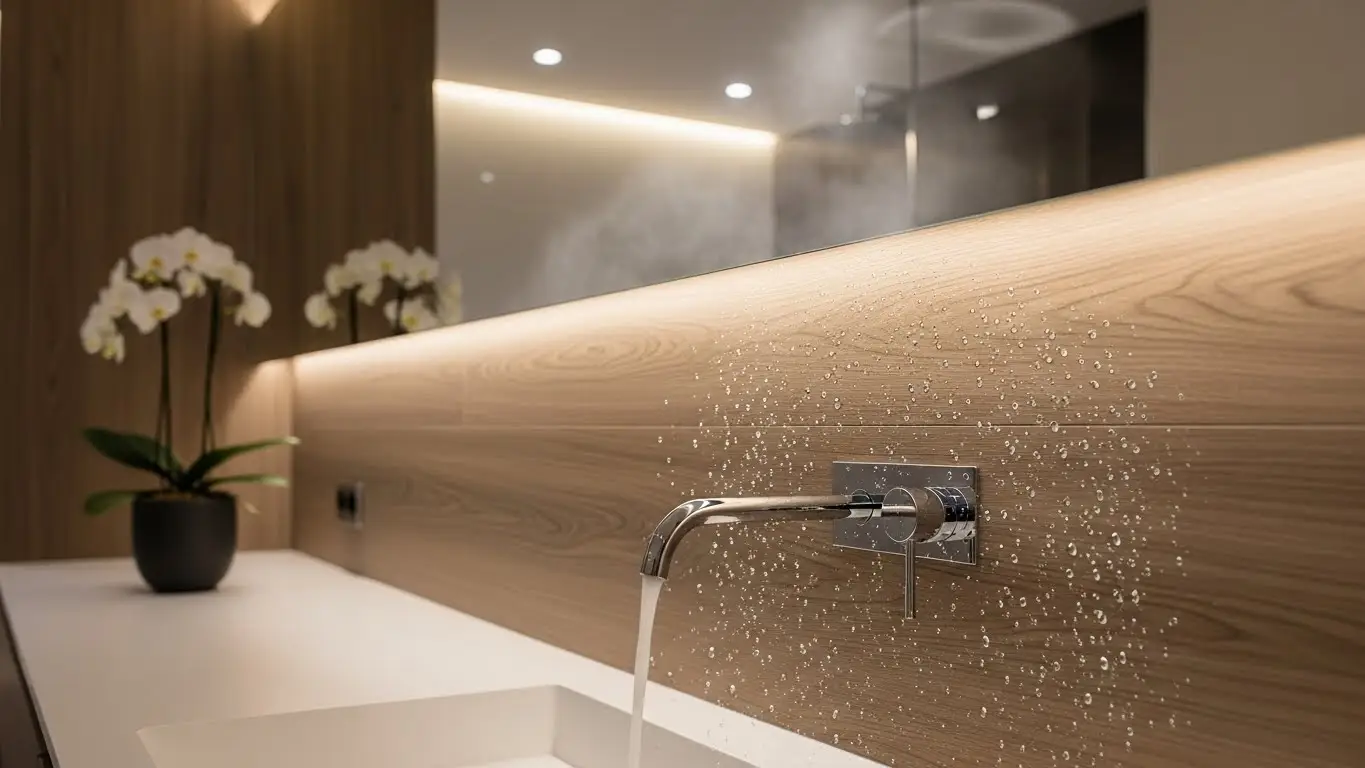
WPC is the only viable option for wet areas because it is non-porous and hydrophobic, meaning it physically cannot absorb water. Wood panels in bathrooms will inevitably warp, rot, or grow mold behind the cladding due to humidity absorption.
We frequently replace rotted wood cladding in renovation projects. The culprit is almost always hygroscopicity—wood breathes. In a bathroom, wood absorbs moisture during a hot shower and dries out later. This cycle causes cracking and warping.
- The HSCS Experience: We have submerged our WPC samples in water tanks for 30 days during quality control testing. The result? Zero swelling.
- The Scenario: If a pipe leaks behind your wall, WPC panels are impervious. You simply unclip them, fix the leak, and reinstall. Wood panels would likely need to be scrapped due to mold growth.
- Sizing Tip: When planning for wet areas, clients often ask what thickness WPC wall panel for bathroom is best. We typically recommend 9mm-12mm panels for optimal structural rigidity and water barriers.
3. Installation & Labor Costs: The Hidden Savings
WPC wall panels reduce installation labor by up to 60% compared to wood because they do not require sanding, staining, or acclimatization. Using a simple interlocking clip system, WPC can be installed directly over rough drywall, unlike wood which requires a perfectly flat substrate.
Real wood requires a master carpenter. WPC requires a general handyman (or a confident DIYer).
- Wood Installation: Requires "acclimatization" (sitting in the room for 48 hours to adjust to humidity). Then comes sanding, sealing, nailing, and filling nail holes.
- WPC Installation: We use an interlocking buckle system. You screw the clip into the wall, slide the panel in, and repeat.
- Material Confusion: Many clients confuse WPC with standard PVC. It's important to understand what is the difference between WPC and PVC wall panels. While both are plastic-based, WPC contains wood fiber and bamboo charcoal, making it denser, more rigid, and more thermally stable than hollow PVC sheets.
4. Maintenance & "The 5-Year Cost"
While WPC panels may have a similar or slightly higher upfront material cost than softwoods, they are significantly cheaper over a 5-year period. WPC requires no varnishing or anti-termite treatment, whereas wood maintenance can cost $2-$4 per sq. ft. annually.
Let’s look at the math from our client case studies:
- Year 1: You pay for the material. Wood might be slightly cheaper if you choose pine.
- Year 2: The wood wall in a sunny room begins to fade (UV damage). You need to re-stain it.
- Year 4: Termite prevention is required for the wood.
- The WPC Reality: After 5 years, our WPC panels simply need a wipe-down with a damp cloth. The UV stabilizers in our co-extrusion layer prevent the "graying" effect seen in natural timber.
5. Eco-Friendliness & Safety
WPC is often more eco-friendly than solid wood because it utilizes recycled plastics and fast-growing bamboo fibers rather than slow-growth old-growth forests. Additionally, high-quality WPC achieves an E0 formaldehyde rating and Class B1 fire resistance, surpassing untreated wood.
At HSCS Decor, we prioritize sustainable manufacturing. A key component of our premium line is Bamboo Charcoal.
- Why Bamboo Charcoal? Clients frequently ask what is bamboo charcoal wall panel. It is a core layer infused with activated charcoal powder. This not only reinforces the panel but also helps absorb odors and purify indoor air.
- Fire Safety: In our factory fire tests, WPC panels self-extinguish when the flame source is removed. Solid wood acts as fuel, accelerating a house fire.
Final Verdict: Which One Should You Choose?
- Choose Solid Wood If:
- You are a purist who demands the "imperfect" beauty of nature.
- Budget for ongoing maintenance is not an issue.
- The wall is in a dry, climate-controlled master bedroom or living area.
- Choose HSCS WPC Wall Panels If:
- You want an "install it and forget it" solution.
- You are renovating a bathroom, kitchen, or basement (high humidity).
- You want the look of exotic hardwoods (like Teak or Walnut) without the exorbitant price tag.
- You need a Class B1 Fire Rated material for safety.
Frequently Asked Questions
Is WPC wall panel cheaper than wood?
Generally, WPC wall panels have a higher upfront material cost ($3-$7 per sq. ft.) compared to softwoods like pine, but are cheaper than hardwoods like teak. However, WPC is significantly cheaper over a 5-year period because it requires no staining, sealing, or anti-termite treatments, reducing long-term maintenance costs to near zero.
Can WPC wall panels be used in bathrooms?
Yes, WPC (Wood Plastic Composite) is superior to wood for bathrooms and high-humidity areas. Unlike solid wood, which is hygroscopic and swells when wet, WPC is 100% waterproof and mold-resistant. It maintains its structural integrity without the need for frequent waterproofing sealants.
How long do WPC panels last compared to wood?
High-quality WPC panels typically last 15-20 years without fading or warping, thanks to UV stabilizers and rot-proof polymer content. In contrast, untreated interior wood panels may show signs of wear, drying, or pest damage within 7-10 years unless rigorously maintained with oil or varnish.
Do WPC panels look like fake plastic?
No, high-quality WPC panels from manufacturers like HSCS Decor use 3D embossing and co-extrusion technology to replicate the texture and color variation of natural wood. While early generations looked plastic, modern bamboo charcoal veneers are visually indistinguishable from wood at a standard viewing distance.
Is WPC environmentally friendly?
Yes, WPC is considered an eco-friendly building material because it uses recycled plastics and fast-growing bamboo fibers, reducing the demand for logging natural forests. Furthermore, reputable brands like HSCS Decor produce panels with E0 grade formaldehyde emissions, ensuring safe indoor air quality.


